


New Feeders Boost EPS Production, Efficiency at Bandex
The new feeders replace disc-type units that never worked properly.Bandex S.A., located in San Luis, Argentina, manufactures disposable containers and plates from expanded polystyrene (EPS). The production line extrudes and thermoforms virgin polystyrene, recycled polystyrene, talc, and masterbatch color pellets. Bandex is the market leader in EPS packaging for fresh produce in Argentina.
When the company began operation in 1988, it planned to become the most important polystyrene packaging supplier in the Mercosur region. Mercosur, also known as the Southern Common Market, includes Argentina, Brazil, Uruguay, and Paraguay. (Chile and Bolivia are associate members.) The region has a population of 220 million.
The Bandex plan included upgrading its manufacturing facility, so the company added disc-type volumetric feeders to the production line. The feeders, built by a recognized manufacturer of feeding equipment, were a critical component of the processing system. But the feeders had a problem. They failed when polystyrene pellets lodged between the discs and the discharge. This had two effects: 1) lost production because of downtime for repairs; and 2) lost production because of poor product quality (inconsistencies in the foam sheet).
Fighting to improve feeding
To meet its production goals, Bandex began a program aimed at maintaining continuous operation of their equipment to gain maximum efficiency. The vision was to have zero unplanned downtime during production, which was 24 hours a day, 7 days week. But the problems with the disc-type feeders continued to be a source of major delays. The facility even had trouble meeting some orders and much production was lost to waste.
"We never received a satisfactory solution to our problem from the [disc] feeder manufacturer and the losses continued," said Juan Antonio Rios, engineering and maintenance manager at Bandex. "On several occasions, parts were promised but never arrived. No recommendations were given to improve the operation of the equipment." Nor did the supplier offer Bandex compensation for its losses, which Rios attributes to the malfunctioning feeders. "The equipment never operated to our satisfaction," Rios said. "Our solution at that point in time was to unload raw material from the silos via screw conveyors to a centralized mixer. This operation was very primitive and basic," he said.
At that time, Rios said, the company's extrusion line was operating at an overall equipment efficiency (OEE) of 90 percent. The OEE rating, a cornerstone of measurement in Total Productive Maintenance (TPM) methodology, assesses the status of equipment and tracks improvement. The basic formula for OEE is: "Availability X Performance X Quality." The higher the OEE rating, the better. According to Rios, an 85 percent rating is the minimum required to be considered a world-class company.
The company quickly boosts its OEE rating from 90 percent to 97 percent.
Bandex was in that class, but clearly there was room for improvement: Workers were handling bags of raw materials manually, dust covered all the equipment, and the manufacturing area had a poor appearance, Rios said. Raw materials accumulated on the floor around the extrusion line because the workers had to stop production so frequently to repair the feeders.
Feeding into the company's growth
In 1994, Bandex continued expanding its production capacity with the purchase of a complete EPS and thermoforming line to work alongside the existing one. Installed in 1995, the new production line had a higher capacity and included automatic hopper loading. Most important, the line used four volumetric feeders and a continuous blender supplied by Acrison International of Moonachie, NJ USA. The design and performance of these feeders were very different from the disc-type units.
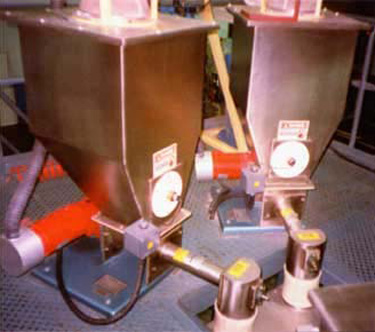
Instead of using a horizontal disc to move the raw materials from the feed hopper, the new feeders used a screw to meter materials. To handle the talc and master batch pellets, two of the feeders (as well as the continuous blender) included a concentric auger within the feed hopper. This auger, which moves at a different speed that the metering screw, ensures the material fills the flights of the metering screw evenly. The result is a reliable feed-rate and a steady discharge to the blender and to the extruder. "The operation has been highly reliable since its start-up 5 years ago," Rios said. That reliability translated into long periods of continuous operation, which increased efficiency. The manufacturing area also stayed clean, Rios added.
Repeating the success
In 1996, Bandex again reached full production capacity. And again, Rios contemplated the limitations of the original production line with its old disc-type feeders. The line continued to give maintenance workers "daily headaches," Rios said. "We needed to fulfill international levels of production, and with these feeders, we were not going to meet our objectives," he said. After analyzing the options, Rios and his colleagues decided to replace the old feeding system with a feeding system identical to the one that the company installed in 1995.
As time passes, the line becomes more reliable and simple to operate.
It was at this point, Rios said, that the Argentine representative for the feeder manufacturer encouraged and helped Rios and Plant Manger Gustavo Busso to visit the feeder supplier's headquarters in the United States. The men toured the manufacturing facility and the customer test laboratory. They also thanked their hosts for the timely technical support over the years. Then Busso placed the order for another feeding system. "We decided on [the same supplier] because its equipment has proven to be efficient and reliable, and the technical support has always been excellent," Busso said.
Next, Bandex worked with the supplier to define the parameters for designing the new feeding system based on the company's production goals. When the plans were ready, Bandex installed two Model 101 volumetric feeders, one for the virgin polystyrene and one for the recycled polystyrene; a Model 105 volumetric feeder for the master batch of color pellets; and a Model 105Z volumetric feeder for the talc. The system also includes a Model 350 blender for combining the ingredients and feeding the mixture to the extruder.
Getting world-class results
Bandex removed the disc-feeders from the old extrusion line and replaced them with the new feeders in 1997. According to Rios, the improvement was immediate and obvious, both in terms of OEE and TPM. As time passed, the line became increasingly reliable and simple to operate, Rios said.
As a result, the operators have more time for the inspections that are required to maintain TPM certification. Before, most of their time was spent on maintenance problems. The manufacturing area also stays dust-free and thus provides a safer environment for the workers. And total production capacity reached 300 metric tons per month. "The new feeding system increased our production capacity by 15 to 20 percent," Rios said. "The OEE and TPM rating rapidly improved, going to 97 percent from 90 percent. The work atmosphere was also more relaxed and confident, and the quality of our product improved tremendously and maintained consistency." In addition, Bandex recovered its investment in the equipment in 12 to 18 months, Rios said, more quickly than forecasted.
Thanks in part to the new feeders, Bandex received ISO 9002 certification in 1998. The company will soon reach the standards of Good Manufacturing Practices (GMP). By 2001, Rios expects the company to receive ISO 14000 certification. "We would not have attained these accomplishments if it weren't for the installation of the [new] feeders," he said.
"Thanks to the collaborative efforts of the Bandex engineering team and [the feeder supplier's] technical personnel, we are able to meet our goals of efficiency, reliability, and continuous operation needed to compete in today's global market."

Click to enlarge
Four volumetric feeders discharge raw materials to a continuous blender, which feeds the mixture to an extruder. Operation is 7 days a week, 24 hours a day.
Click to enlarge
The feeder hoppers re-load automatically and never quit, unlike the old feeders. In addition, Bandex receives timely technical support from the feeder manufacturer.