


Feeders Exceed Company's Requirements
Volumetric and loss-in-weight feeders accurately feed a custom compounder's ingredients to its extrusion lines.O'Neil Color & Compounding Corp., a subsidiary of Primex Plastics Corp., produces custom colorant and additive master batches and thermoplastic compounds for customers that make injection molded, blow-molded, extruded, and other finished plastic products. In 1992, the company purchased a compounding plant in Jasper, Tenn., that had several existing extrusion lines for making custom-formulated products. Depending on the line, either volumetric or loss-in-weight (LIW) gravimetric feeders fed ingredients into the extruders. O'Neil Color knew that accurate and reliable feeders were essential for their new plant's production to be successful.
"We typically color match and tailor a compound's physical properties to a customer's specifications, so we need feeders that can accurately feed such varied ingredients as polymer resin pellets, color pigment powders, and other additives into the extruders," says Mark Bruner, O'Neil Color president. "If just one feeder in an extrusion line can't consistently feed an ingredient at a controlled feedrate with repeatable accuracy, the finished product will be different for every batch. Additionally, for us to maintain production rates and minimize production costs, the feeders must be reliable, requiring little maintenance while providing a long operating life to maximize extrusion line uptime."
O'Neil Color soon found that the existing feeders met the criteria, allowing the company to consistently produce high-quality products for its customers.
Making a custom-formulated product
The Jasper plant, which serves as the company's headquarters, operates 24 hours a day, 5 days a week, and produces more than 40million pounds of products per year. The company makes each product in large batch runs in which up to 15 ingredients are metered into an extruder where they're heated, melted, and thoroughly mixed. The molten product discharges to the downstream process and is extruded, dried, pelletized, classified, and finally packaged for shipment to the customer.
To make a product, an operator accesses the plant's central computer database, which stores each product formulation, and calls up the appropriate formulation. The operator then prints out the formulation's bill of materials, which includes such information as the required ingredients, individual ingredient amounts, feeder settings, and a batch-blending sheet if multiple ingredients require preblending. After preparing the ingredients to be fed into the extruder, the operator checks each feeder and adjusts the feedrate if necessary before starting up the extrusion line.
For a volumetric feeder, which typically feeds preweighed and preblended ingredients at a preset feedrate, the operator adjusts the feeder's motor speed to ensure that the proper material volume is fed into the extruder. For an LIW gravimetric feeder, which typically feeds a single ingredient, the operator enters the feeder's setpoint into the extrusion line's multifeeder processor to ensure that the correct material amount is metered into the extruder.
Feeders play important role in extrusion process
When the company purchased the Jasper plant, the plant was operating four extrusion lines and using seven volumetric and five gravimetric feeders. The feeders were supplied by Acrison, Moonachie, N.J., a supplier of dry solids metering and handling equipment and systems, including volumetric feeders, gravimetric feeders, multifeeder controllers, and control systems.
Over the years as customer demand increased, the company has expanded the plant's production operation several times, adding new extrusion lines to increase production capacity and produce more diversified products. "Each time, before adding the new lines, we evaluated other feeder brands, but we didn't find any that brought anything new or better to the process," says Bob Anthony, Jasper plant manager. "The supplier's feeders have proven themselves to be accurate and reliable, so we've continued adding them to the extrusion lines as we've expanded and upgraded the plant's operations."
The volumetric feeders
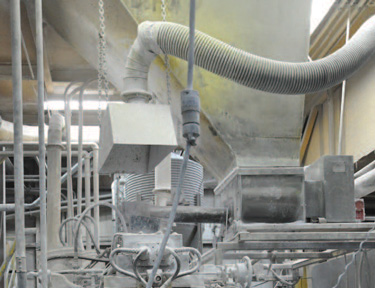
The stainless steel single-screw volumetric feeders feed materials into the extruders by volume at a preset feedrate, which is expressed as volume per unit time, such as cubic feet per hour. A feeder's AC variable-frequency drive rotates the horizontal feed auger and controls the feedrate to an extruder. The feeders in the Jasper plant range in size and hopper capacity and have output capacities from 0.5 to 160 ft3/h.
The feeders are well-suited to handling a range of materials with various particle sizes, from free-flowing powders, granules, and pellets, to clumpy and cohesive agglomerates. Materials these feeders handle at the Jasper plant include polymer resin pellets, pigments and powders, pellet powder blends of various ratios, and other powder additives and blends.
For a volumetric feeder to consistently feed materials accurately, the material being fed must maintain a constant bulk density. To ensure this, some of the supplier's feeders have either a single or dual conditioning auger-agitator installed in the hopper that conditions the material during feeding. A conditioning auger-agitator also helps deliver an even and steady material flow to the feed auger, ensuring that it's always full during operation and that there are no empty spaces between the feed auger's flights. The conditioning auger-agitator is independently driven in a preestablished ratio to the feed auger, and its rotation speed and direction (inward or outward) are determined by the characteristics of the material being fed. To help further condition a material, an auger-agitator can have conditioning aids that attach to the auger-agitator and extend out almost to the hopper walls.
The LIW gravimetric feeders
The LIW gravimetric feeders, which are constructed of stainless steel, feed materials into the extruders by weight at a controlled rate as determined by a setpoint, which is expressed as weight loss per unit time, such as pounds per hour. A gravimetric feeder consists of a weigh hopper, a feeder with an AC variable-frequency drive mounted below the weigh hopper, and a non-load-cell platform weighing system with a split-beam lever weighing network. The hopper, feeder, and ancillary equipment are mounted on a platform that sits on the weighing mechanism. The weighing system uses the supplier's Ratiometric Digital Weight Resolver Weight Sensing System with synchro-resolver technology to provide ultrahigh-resolution weight sensing and precise weighing accuracy. The feeder's weighing system monitors the material weight numerous times per second to ensure a typical feeding accuracy of ±0.25 to ±1.0 percent or better at 2 sigma based on a given number of consecutive 1-minute weighments.
The gravimetric feeders in the Jasper plant range from small units with 1-cubic-foot-capacity hoppers to larger units with 15-cubic-foot-capacity hoppers. Based on an average bulk density of about 35 lb/ft3, these feeders can feed materials at rates from 0.5 to 1,200 lb/h. The feeders are well-suited to handling the same materials as the volumetric feeders as well as some other difficult-to-handle, abrasive materials. Materials these feeders handle at the Jasper plant include polyethylene resin pellets and flakes, metallic oxide blends, calcium carbonate, carbon black, powder-pigment blends, and other powder additives and blends.
In operation, an operator enters a setpoint into an extrusion line's multifeeder processor specifying the desired feedrate for a specific gravimetric feeder. After the feeder is started, material flows from the weigh hopper into the feeder's feed chamber, and the horizontal feed auger moves the material out of the feeder into the extruder. The weighing system continually monitors the weight of the material in the weigh hopper and calculates the material weight loss per unit time. The feeder controller compares the calculated loss in weight to the setpoint and signals the feeder's drive to either speed up (increase the feedrate) or slowdown (decrease the feedrate), thus maintaining an accurate, controlled feedrate.
Feeders fit the bill
The feeders allow the company to have confidence that a product will be the same with every batch. "In a manufacturing operation like ours, feeder reliability and accuracy are the two things that we count on, and the supplier's feeders fit the bill," says Bruner. "Reliability so the extrusion line doesn't go down, and accuracy so a product meets a customer's specifications every time. We have yet to see an application that the supplier's feeders can't handle."
The company's operators require minimal training to operate the feeders. "The volumetric feeders basically have a speed-selector and an On/Off switch, so you're not talking about a lot of technology there," says Anthony. "The gravimetric feeders are a little more sophisticated, but our operators can still easily program and operate them. The feeders are also easy to clean out between product runs to prevent cross-contamination, and their design makes it easy to change out the feed augers."
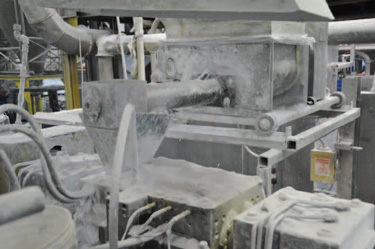
According to Bruner, the supplier's feeders are rugged machines, requiring minimal maintenance. "For the most part, the little maintenance we've seen has been needed because the feeders have gone above and beyond the call of duty. And whenever we've had a problem with a feeder, the supplier has provided good customer support; they're very responsive."
Currently, the Jasper plant is operating 11 extrusion lines and using 17 volumetric feeders and 7 gravimetric feeders. Nine extrusion lines use dedicated volumetric feeders, while the other two lines use dedicated gravimetric feeders.
The company is more than satisfied with the supplier's feeders. "We need top-end feeders with heavy-duty stainless steel construction because we run them so hard twenty-four hours a day, and the supplier's feeders provide that," says Anthony. "We're happy with their feeders and service, and, moving forward, we plan to continue using them if we add a new extrusion line to the plant. It's about reliability, accuracy, and customer support."
Click to enlarge
This volumetric feeder reliably meters a color concentrate into an extruder, ensuring batch consistency and continuous operation.
Click to enlarge
This rugged volumetric feeder has stood the test of time, easily enduring the company’s unforgiving industrial environment while requiring minimalmaintenance.