


Feeders Provide Highly Accurate, Repeatable Feed Rates
A toll compounder chooses durable and reliable loss-in-weight feeders for a new production line.In 2005, Randy Rudisill and Dave Donie, both former top executives of a major plastics company, founded American Compounding Specialties (ACS) to toll-compound various thermoplastics and specialty resins for companies in the plastics and chemical industries. ACS was initially formed to fill a void in the custom-compounding market by using advanced product quality planning (APQP) techniques, a systematic approach designed to ensure top-quality products and customer satisfaction. Rudisill and Donie, who have more than 65 years combined experience working in the plastics industry, aimed to guarantee their customers a 99 percent yield rate, which is considerably higher than the more typical 90 to 93 percent rate, says Donie. The partners knew that to accomplish this, the production line for the company's new 17,500-square-foot plant in Fowlerville, Mich., would require accurate and reliable equipment, including several loss-in-weight (LIW) weigh feeders.
The toll-compounding production process
ACS operates 24 hours a day, 7 days a week, toll-compounding polypropylene, nylon, polycarbonate, ethylene vinyl acetate, and other products for its customers. In April 2006, the company first began operations with one production line consisting of a twin-screw extruder, a preblender, two raw material desiccating dryer-hoppers, several raw material hoppers, control panels, a classifier and pellet cooler, packaging equipment, and several feeders to accurately feed powders, pigments, pellets, fiberglass, liquids, and other materials into the process.
Customer raw materials and additives arrive at the toll-compounding plant in various containers: Powders are shipped in bags and drums, resin pigments and specialty additives in bags, resin pellets in gaylords, chopped-strand fiberglass in bulk bags, and mica, talc, and iron ferrite in bulk bags. The various powders and pigments, which include difficult-flowing materials, have particle sizes ranging from 0.5 to 20 microns, the resin pellets are about 1/8 inch in size, and the chopped-strand fiberglass is about 4 microns.
To make a product—for example, one consisting of nylon 6 and nylon 6-6—an operator stages a gaylord of each material in a box-tipper with a dedicated bin. Each box-tipper empties the material from the gaylord into its bin, which is connected to a dedicated vacuum conveying system with a 3-inch-diameter pipe. Each conveying system moves the material from the bin vertically about 30 feet, discharging it into a dedicated 500-pound-capacity dryer-hopper. The two desiccating dryer-hoppers are located on the second tier of a two-tier mezzanine and installed directly above the 1,000-pound-capacity preblender, which is installed on the mezzanine's first tier. The dryer-hoppers remove moisture from hygroscopic materials so that they enter the downstream process with a known moisture content.
The materials discharge from the dryer-hoppers into the preblender, which creates a homogeneous blend. At this stage, the operator can also add stabilizers, pigments, and other specialty additives if required by the product formulation. The preblender also acts as a refill device for the main feeder, which has a 1,000-pound-capacity hopper and is positioned directly below the preblender on the main floor next to the extruder. When the main feeder's hopper reaches a low level, the feeder signals the preblender to discharge a batch to refill the hopper. An alarm simultaneously sounds to alert the operator to make another blend while the feeder's hopper is full. This allows the production process to operate continuously.
A product formulation can have 15 or more ingredients, and the LIW weighfeeders are used throughout the production line to meter the various materials into the twin-screw extruder. The main feeder feeds pellets, powders, and pellet-powder blends into the extruder, which heats up the materials and melts and mixes everything together. Two secondary feeders add minor and specialty ingredients such as fiberglass and talc. And liquid ingredients are added by a liquid LIW feeder with a metering pump.
After passing through the extruder, the molten product discharges to the downstream process where it's shaped, cooled, dried, pelletized, classified, and finally packaged for shipment to the customer. During each production run, ACS conducts in-process testing to ensure quality and guarantee the customer a high-quality, high-yield product every time.
Selecting the feeders
According to Donie, when he and Rudisill were planning to start ACS, they knew that the production line's feeders would be supplied by Acrison Inc. The Moonachie, N.J., company supplies dry solids metering and handling equipment and systems, including weighfeeders, volumetric feeders, multifeeder controllers, and controls systems. "I've worked with the supplier a lot in the past and, in my opinion, they have the best feeders on the market," says Donie. "That's why we specified their feeders from the very beginning. We needed feeders that are easy to clean between product runs and are able to handle a wide range of dry solid materials, from difficult-to-handle powders and fibers to pellets and flakes. The supplier's feeders do that. They're also reliable and durable, which was essential."
Donie says that an improperly functioning feeder is one of many things that can cause material waste, which decreases product yield rates and increases customer costs. For example, if a feeder's feedrate varies even a little, it can destabilize the process so that it produces a poor-quality product, or scrap, which decreases yield rates. Or, if a feeder deviates too much, the production line will shut down, "which also produces scrap and raises a customer's costs," says Donie, "because we have to purge about three hundred pounds of product before restarting the line. So the accuracy, reliability, and repeatability of the supplier's feeders help us keep yield rates high and customer costs low by eliminating such problems."
The feeders
ACS's production line includes three LIW weighfeeders, and one volumetric feeder. The LIW feeders use a non-loadcell platform weighing system with a split-beam lever weighing network. With this system, the feeder's hopper and ancillary equipment are mounted on a platform that sits on the weighing mechanism. The weighing system uses the supplier's Ratiometric Digital Weight Resolver Weight Sensing System with synchro-resolver technology to provide ultra-high-resolution weight sensing and precise weighing accuracy. Each LIW feeder's weighing system, which is calibration and adjustment-free, monitors a hopper's weight numerous times per second to ensure a feeding accuracy of ±0.25 to ± 1.0 percent at 2 sigma for every 1-minute interval.
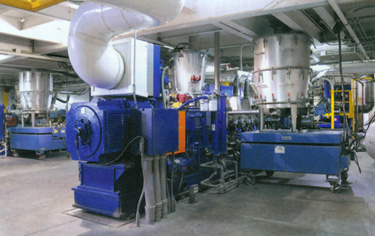
The production line's main feeder is a Model 404X-170-3 LIW Weighfeeder that has a 20-cubic-foot-capacity stainless steel hopper with a bolted access door. The feeder's 1.5-horsepower variable-speed motor drives a solid-flight stainless steel feed auger and can feed pellets, powders, and pellet-powder blends with up to 10 percent powder at 3,000 to 4,000 lb/h. The feed auger has a special release-coating on it to improve feeding accuracy. A 1.5-horsepower single-speed motor drives the hopper's conditioning agitator auger, located in the hopper bottom, to ensure positive material flow out of the hopper and directly into the feed chamber. The feeder is mounted on casters and is 42 inches wide, 78 inches long, and 83 inches tall with the hopper.
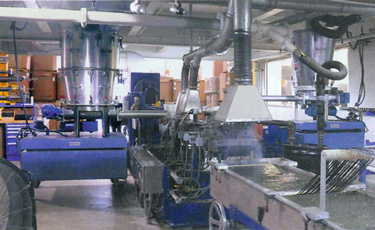
The line's two secondary feeders are Model 402-170-1 LIW Weighfeeders, and each has a 6-cubic-foot-capacity stainless steel hopper. Each feeder's 0.5-horsepower variable-speed motor drives a helical feed auger and can feed calcium carbonate, fiberglass, and other specialty additives at 1,000 to 2,000 lb/h. A 0.75-horsepower single-speed motor drives each feeder's conditioning agitator auger. These feeders are also mounted on casters, and each is 26 inches wide, 49 inches long, and 66 inches tall with the hopper.
The line's stationary refill device is a Model 130-2 Volumetric Feeder with a 20-cubic-foot-capacity hopper and a downspout with a slide-gate valve mounted on the discharge end of the feed auger. The feeder's 3-horsepower single-speed motor drives an 8-inch-diameter solid-flight feed auger and can feed materials at 300 to 1,000 lb/h. The feeder is dedicated to refilling one secondary feeder's hopper with 5.6 cubic feet of mica, talc, or other additive about 4 to 6 times an hour when operating.
Expanding production capacity
In summer 2007, after 1 year of successful operations, ACS decided to install a second production line to increase the plant's annual production capacity from 30 million to 60 million pounds. For the second production line, a mirror of the first, Donie again specified that the supplier's feeders be used to feed the various materials into the process.
During the 2007 production line expansion, ACS also installed the supplier's recently developed monitoring and control system and connected it to each feeder's SBC-2000 weighfeeder controller to better manage the production process. The supplier's Acri-Data Windows-based supervisory software program is installed on the company's central PC, which is connected to each feeder's controller via field wiring. This allows ACS to collect data from each production run, store it in a database, and track every aspect of the production process.
"The monitoring and control system also has a recipe system," says Donie, "so when I go to make a product, I just access the database, pull up the product's formulation, and hit Enter. The system then automatically configures the feeders to the correct operating parameters, eliminating the need to manually configure each feeder individually."
Click to enlarge
The production line's main feeder (right foreground) has a 20-cubic-footcapacity stainless steel hopper and feeds pellets, powders, and pellet powder blends at up to 4,000 lb/h.
Click to enlarge
The production line's secondary feeder (right background) has a 6- cubic-foot-capacity stainless steel hopper and feeds calcium carbonate, fiberglass and other specialty additives at up to 2,000 lb/h.
Click to enlarge
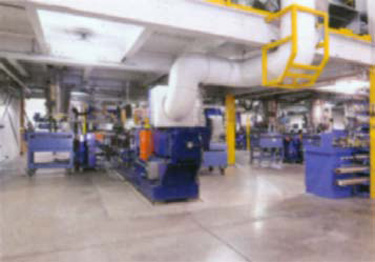
The toll compounder's two production lines annually produce more than 60 million pounds of thermoplastic and specialty resin products.