


Loss-In-Weight Gravimetric Feeders Help Boost Company's Production Capacity
A custom compounder selects reliable and accurate loss-in-weight gravimetric feeders for a new extrusion system.Network Polymers, Akron, Ohio, produces highly engineered, custom thermoplastic resins and alloys for the automotive, medical, hardware, and many other industries. At the end of 2010, the company wanted to increase production to meet customer demand for newly developed products made with specialized powder and pellet blends. To accomplish this, the company needed a new turnkey extrusion system for the compounding facility. The company worked with a nearby Ohio-based extrusion equipment manufacturer and systems provider when designing the extruding line and selecting loss-in-weight gravimetric feeders to meter the various powder and pellet blends into the extruder.
Expanding the extrusion process
The company's manufacturing processes require extremely consistent and accurate feeding equipment to meter the various powder and pellet blends into the extruders to ensure consistent product quality and optimal operational efficiency. For this reason, Network Polymers uses a variety of loss-in-weight gravimetric feeders for the various extruding lines in the facility. The feeders feed materials into the extruders by weight at a controlled rate, typically in pounds per hour.
Toward the end of 2010, the company developed project possibilities for new products that required additional production capacity. However, because many of the products are made with difficult-flowing powder and pellet blends, the company's existing feeders couldn't effectively handle them. To handle the increased production, the company needed to develop a new extruding line with feeders that would consistently and precisely meter the challenging blends into the extruder.
Finding the right feeders
When the company began planning the extrusion system, it contacted NFM Welding Engineers Inc., Massillon, Ohio, an extruder manufacturer and systems supplier for the plastics and rubber industries. The company had successfully worked with Jim Surma, NFM TEM (Toshiba Extrusion Machine) sales manager, in the past on similar projects with demanding compounding conditions that required extrusion systems with integrated feeders, controls, and ancillary equipment. For this project, NFM worked closely with the Network Polymers engineering team when selecting the new extruder and feeders and programming the system to meet the company's required throughput and quality specifications. To ensure that the company selected the best feeders for current and future applications, NFM invited sales reps from various feeder suppliers to the NFM facility to present information about their feeder capabilities to the engineering team.
After reviewing the presentation information and feeder test results from each supplier, the engineering team chose to purchase loss-in-weight gravimetric feeders manufactured by Acrison, Moonachie, N.J. This feeder supplier provides dry solids metering and handling equipment and systems, including volumetric and gravimetric feeders, multifeeder controllers, and control systems to the plastics, chemical, food, and other industries. The supplier's manufacturers' representative for Ohio, Dan Roessler, Roessler Co., Cleveland, worked closely with both Network Polymers and NFM to facilitate material tests, feeder selection, and feeder commissioning. Following feeder selection, NFM assembled and proved the extrusion system and feeders in its process development lab to ensure efficient operation and ease startup in the company's facility.
According to Brian Rowles, Network Polymers plant operations manager, the team selected the supplier's feeders because of their accuracy, repeatability, robustness, and ability to effectively meter the difficult-flowing raw materials. "We also liked that they had large-capacity hoppers, which means we don't have to fill them as often during a twenty-four hour period," he says. "This provides operational stability because any time a hopper is filled with material, there's a possibility for error that can cause feeding variations that negatively affect finished product quality. Depending on the material, the hoppers are filled about every thirty-five to forty minutes, whereas the other suppliers' hoppers would've needed to be filled about every fifteen to twenty minutes."
The loss-in-weight gravimetric feeders
In June 2011, NFM delivered the turnkey extrusion system to the company's facility, integrated and programmed the feeders and ancillary equipment, and started it up. The extrusion system includes a model TEM-58SS twin-screw extruder, a mezzanine, six loss-in-weight gravimetric feeders, one loss-in-weight liquid feeder, seven feeder controllers, a pelletizer, and ancillary equipment that's all integrated with NFM's centrally located Aries II HMI controller.
Each stainless-steel loss-in-weight gravimetric feeder consists of a hopper, a feeder with an AC variable-frequency drive mounted below the hopper, and a non-load-cell-based platform weighing system with a split-beam lever weighing network. The hopper, feeder, and ancillary equipment are mounted on a weighing mechanism. The weighing system uses the supplier's Ratiometric Digital Weight Resolver Weight Sensing System with synchro-resolver technology to provide ultrahigh-resolution weight sensing and precise weighing accuracy. The feeder's weighing system monitors the material weight numerous times per second to ensure a typical feeding accuracy of ±0.25 to ± 1.0 percent or better at 2 sigma, based on a given number of consecutive 1-minute weighments.
Two Model 405-1015X loss-in-weight feeders, each with a 5-cubicfoot-capacity hopper, feed polymer modifiers and powders with bulk densities of 33 lb/ft3 at 30 to 800 lb/h. One Model 405-1015X loss-in-weight feeder with a 5-cubic-foot-capacity hopper feeds masterbatches and powders with bulk densities of 33 lb/ft3 at 60 to 600 lb/h. These three feeders have material contact parts constructed of Type 304 and Type 316 stainless steel and feature a dual auger-agitator metering mechanism and a quick-cleanout design for rapid product changeover requirements.
Three Model 407-101-0 loss-in-weight feeders, each with 3-cubicfoot-capacity hoppers, feed resin pellets with bulk densities ranging from 35 to 38 lb/ft3 at 350 to 650 lb/h. These three feeders feature a compact scale design ideally suited for the company's facility and incorporate quick assembly/disassembly devices to facilitate cleanout and product changeover.
Seven Model SBC-2000 CM control modules mounted in a NEMA 12, multidoor, free-standing enclosure are connected to a control panel that features a 17-inch color touchscreen HMI. The controller uses the supplier's Acri-Data Supervisory Software package that allows operators to access and modify feeder setpoints, calibration entries, and other functions.
In operation, an operator calls up a recipe on the extrusion system's main controller and pushes the start button. When the main controller activates the feeders via the feeder controllers, material flows from the hopper into the feeder's metering mechanism, and the horizontal feed auger moves the material out of the feeder into the extruder. The weighing system continually monitors the material weight in the hopper and calculates the material weight loss per unit time. The main controller compares the calculated weight loss to the setpoint and signals each feeder's drive to either speed up (increase the feedrate) or slow down (decrease the feedrate) to maintain an accurate, controlled feedrate to the extruder.
Achieving accurate feeding results
The company operates the compounding facility 24 hours/day, 5 days a week, and since installing the new extrusion system, the loss-in-weight gravimetric feeders have functioned flawlessly. "NFM and the feeder supplier provided us low-cost reliable equipment that efficiently produces a wide range of high-quality custom compounds for our increasing and diverse customer base," says Rowles. "I've worked in other compounding facilities that have used the supplier's feeders, and they've always been dependable feeders. The supplier's customer service has also been exceptional; anytime we've had a technical question or issue, they've gotten back to us within four hours. And because they manufacture their own parts, they're able to tell us exactly how long it will take to get a new or replacement part, so we're not waiting around for it."
The feeders' electronic weighing system ensures accurate feedrates to the extruder, which allows the company to consistently produce high-quality products for its customers. "There are no load cells that can wear out," says Rowles. "And because there are no load cells, there's no chance for drift, which occurs when a load cell fails and the amount being fed into the extruder no longer matches the feedrate setpoint. This negatively affects the end product's quality and operational efficiency because we have to shut down the line to fix the problem. We don't have to worry about that problem with this supplier's feeders."

Click to enlarge
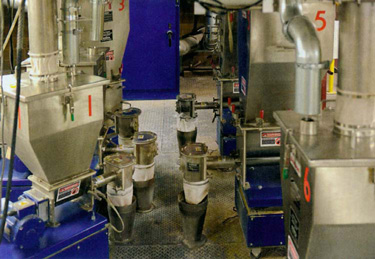
The six loss-in-weight gravimetric feeders and feeder control panel (back left)are installed on a mezzanine directly above the twin-screw extruder.
Click to enlarge
The feeders meter the powder and pellet blends to the extruder at rates from 30to 800 lb/h, depending on the material, and with a feeding accuracy of ±0.25 to±1.0 percent or better at 2 sigma.
Click to enlarge
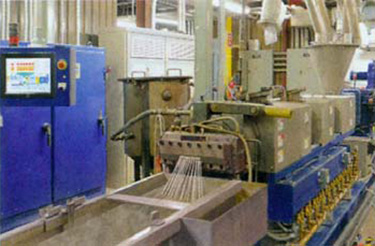
The strands of heated thermoplasticresin discharge from the extruderinto a water bath, where they’recooled before being pelletized.