


Blenders, feeders double output, labor efficiency
Three-year payback with improved quality and housekeepingBuddy's Plant Plus Corp. sought to optimize its production of water-soluble fertilizer and to reduce labor costs at its Ballinger, TX, plant. Loss-in-weight feeders and enclosed continuous blenders increased production from 62 tpd (tons per day) to 140 tpd. Labor requirements were reduced from 10 people in a 10-hr day to four people in an 8-hr day.
Buddy's produces a variety of water-soluble plant foods/fertilizers. Because its original manual batch-and-mix system was fed by 50-lb and 100-lb bags, Buddy's Vice President of Operations Edward J. Studer sought a bulk system to meet the growing sales requirements of Buddy's fertilizers. He wanted to remove the single batch system and install a semi-continuous process.
Labor-intensive manual process
"It just made sense to do it in a progressive way," Studer says. "Our mixing crew, consisting of 10 people, operated 10 hr a day to produce 62 tons for an 8-hr packaging shift. We couldn't mix product as fast as we could package it,
forcing us to look for another method." Buddy's operates five days a week, working the day shift only.
Studer says the process was very labor intensive. Buddy's formulated a batch in bags; weighed the partial bags and small quantities of ingredients, called "pieces," in fiber drums; manually added the materials into one of five 40-cuft
mixers; mixed the batch for 20 min and discharged the batch from the mixer. The time required to complete a 1-ton batch for the packaging process was about 40 min, including 20 min for mixing.
Full and partial bags of raw materials from the warehouse were placed on a pallet after weighing pieces on a 500-lb digital scale. For example, if a batch required 740 lb of mono-ammonium phosphate (MAP), seven full bags and a
40-lb container were set aside for mixing in a product blend. Up to 30 batches were pre-batched on pallets waiting to be mixed.
"We had to get 2 hr ahead of the packaging crew to keep them from waiting on product," Studer says. "We had an accurate system, but it wasn't big enough, and it was too slow. A new system had to have bulk storage and transfer,
high production output and good qualitative analysis."
Seeking a better way
Studer visited another fertilizer producer that used a weigh belt system. He felt that an open-belt type of system was unsuitable because of housekeeping problems with dusting and product falling off the belts. Also, Buddy's product is very hygroscopic, being water soluble, which presented other problems. Studer required a closed system.
Studer also ruled out volumetric feeding directly from silos because analytical results would not match Buddy's stringent 98.9% accuracy record. Additionally, stainless-steel construction was a requirement.
After a year's search, a supplier of loss-in-weight feeders was contacted that met all the requirements, and lab testing confirmed 99% accuracy for Buddy's batch system. Before committing to purchase the system, Studer visited several plants, including a salt plant. Buddy's also spent three months testing the equipment before purchase.
New bulk system
A 40-ft high building was added to accommodate the new system, including four 120,000-lb silos, two each for urea and potash, two of the four main ingredients. These ingredients are delivered in either pneumatic or hopper-bottom trucks. Buddy's new system includes a vacuum conveying system to unload these bulk raw materials to their silos. The materials are pneumatically conveyed to two 5-ton staging "mini-silos" located above the feeders.
Two other raw materials, MAP and diammonium phosphate (DAP), are delivered in 1-ton sacks. An operator fills two additional staging mini-silos with MAP and DAP from five sacks using a building crane. The sacks empty in about 1 min.
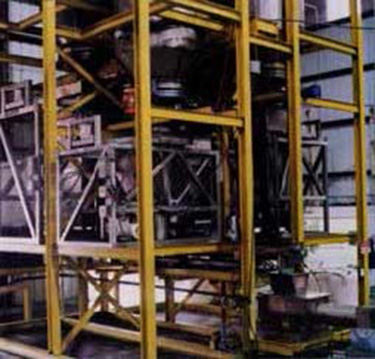
A fifth staging mini-silo has a blend of trace elements such as iron, manganese and zinc. Each staging mini-silo has a vibrating bin activator and a pneumatic, 12-in, knife gate valve to control material flow to the loss-in-weight feeders.
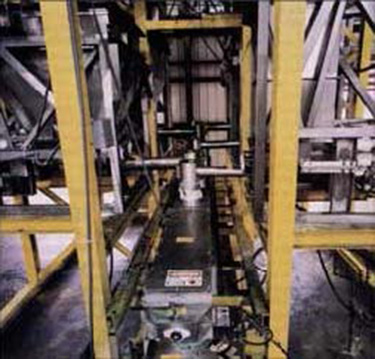
The feeders measure ingredients into a 20-ft continuous blender. The feeding of raw materials to this long screw mixer is timed from the first to the last so the blend is constant throughout. Then, the product is discharged into a smaller, 8-ft horizontal blender. The final product is then packaged.
"No one touches the product with this system. The operator sits in an air-conditioned control room," Studer says. The previous manual, open system created a dusty environment and a housekeeping chore. The new system is enclosed, providing a clean environment.
Increased output
"Our biggest benefit is increased output," continues Studer. "Now, we produce 140 tons of product in an 8-hr shift compared to 62 tons previously in a 10-hr shift, and we do it now with six fewer people. The packaging department is
never waiting on products. Production always has product waiting to be packaged, which is a much better situation to be in."
"We are also getting better product analyses. We eliminated all human errors," Studer says. Batch reject rates declined from 2% to 0.2%. Batch sampling declined from 10 batches per day to five batches per day. Studer estimates a three-year payback.
- Model 403 "Weight-loss" Weigh Feeder and Models 301 and 350 Dry Solids Continuous Blenders - Acrison Inc., Moonachie, NJ.
- Vacuum and Pneumatic Conveyors - Smoot Co., Kansas City, KS.
- Model KBA-5-HD Vibrating Bin Activator - Kinergy Corp., Louisville, KY.
Plant profile
Buddy's Plant Plus Corp. began its water-soluble fertilizer operation in 1988. Currently employing 65 people, the company is owned and operated by the Studer family.
Production capacity has increased from 1,000 tpy (tons per year) in the original 15,000-sq-ft building to 10,000 tpy in the new 180,000-sq-ft facility.
Click to enlarge
Five loss-in-weight feeders meter raw materials into a 20-ft continuous ribbon blender, providing a constant product composition for packaging.
Click to enlarge
The 5-ton staging "mini-silos" feed raw materials into loss-in-weight feeders. Each of the mini-silos has a vibrating bin activator and a 12-in, knife gate valve. A 20-ft blender empties into another horizontal blender.